.svg "Agentic AI in CPG: Why “CPG‑native” matters more than ever")
Agentic AI is quickly becoming the next buzzword in enterprise software. Everyone now claims to have “agents.” And with that claim come promises of autonomy and faster decisions. That’s not surprising. Industries like retail — and by extension CPG — run on large volumes of data, require constant decisions around pricing, assortment, and promotions, and rely on highly repeatable commercial workflows. On paper, CPG looks like a perfect fit for agentic AI.
Then why do we see so many early implementations disappoint?
The issue isn’t the idea of agentic AI itself. It’s how most of it is built. Too often, agentic AI sits outside the commercial system — bolted on as a chatbot, a copilot, or a task‑level automation layer that doesn’t truly understand the commercial reality it’s meant to operate in. And in an industry where small decisions compound quickly, how agentic AI is built matters far more than how impressive it sounds in a demo.
The problem with bolted‑on agentic AI in CPG
Most agentic AI on the market today starts from a generic foundation.
A chatbot gets added on top of an existing CRM or analytics stack.
An agent is wired up to trigger tasks across disconnected tools.
Some “CPG flavor” is layered on through prompts, templates, or dashboards.
The result often looks compelling at first — but quickly breaks down in practice.
Why? Because CPG decision‑making is deeply contextual.
Commercial decisions depend on:
- Deterministic pricing and promotion logic
- Guardrails defined by net margin targets, floor pricing, and trade policies
- Tight coupling between analysis, planning, and execution
- Daily operational checks and long‑term RGM strategy living in the same system
A generic agent may sound like a CPG expert.
But it doesn’t actually live inside the commercial logic that governs the business.
That’s the difference between a chatbot with a CPG skin — and CPG‑native agentic AI.
.png?width=3749&height=1959&name=In%20CPG%2c%20architecture%20determines%20intelligence-2%20(1).png)
What “CPG‑native agentic AI” really means
CPG‑native agentic AI doesn’t start with language models. It starts with the commercial operating model.
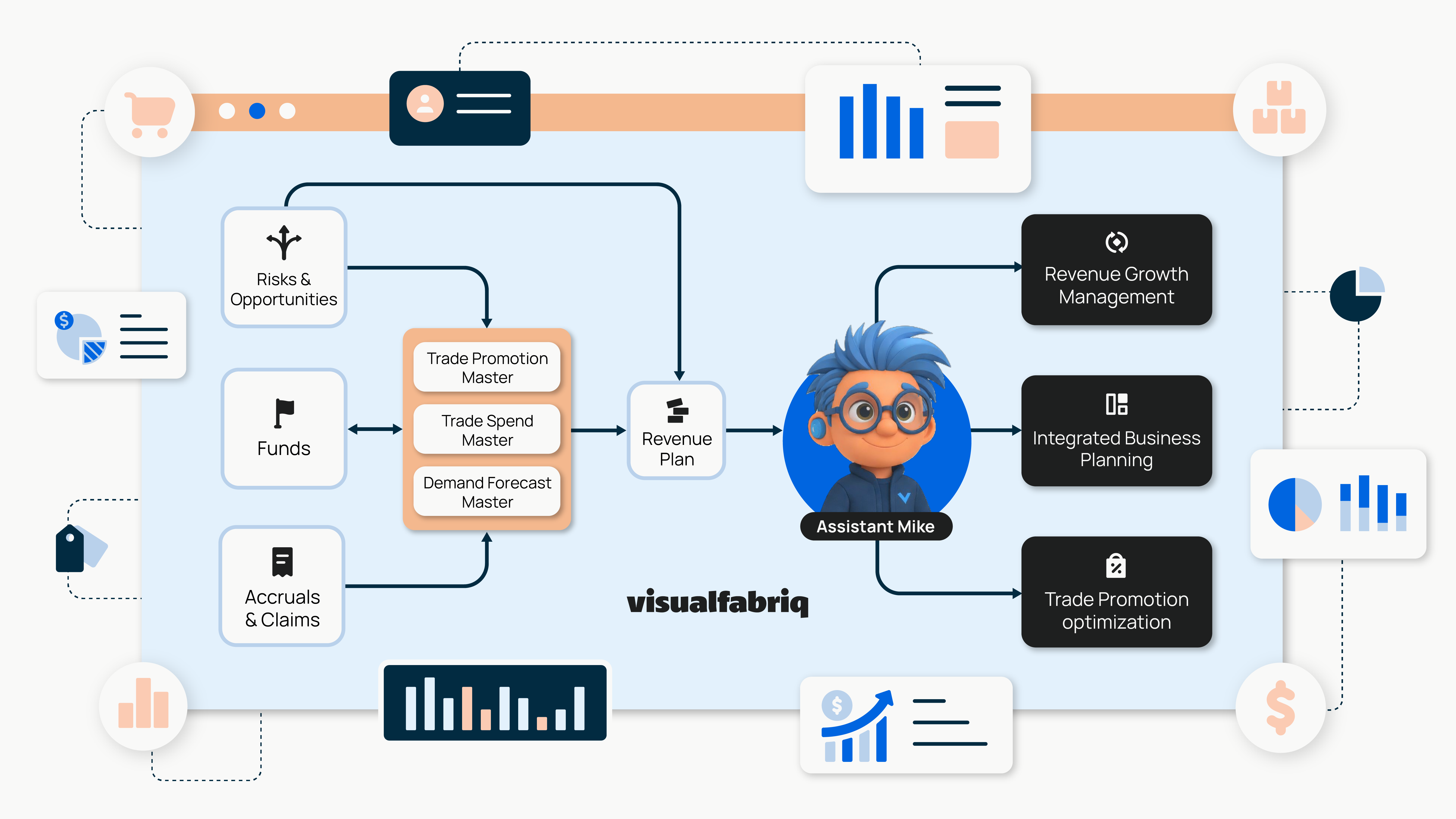
At Visualfabriq, our view is simple: agentic AI for CPG must be built inside the system that already runs Revenue Growth Management, Integrated Business Planning, and Trade Promotion Management and Optimization — not bolted on afterward.
That’s what enables intelligence that is:
- Coordinated, not fragmented
- Governed, not improvised
- Executable, not theoretical
Agentic AI shouldn’t just answer questions like “What happened?” or “What might happen?” — or even stop at “How can I work faster?”
It should help teams close the loop from insight to action — on terms defined by the business itself.
From isolated automation to orchestrated commercial intelligence
A lot of current AI innovation focuses on automating individual tasks:
- Drafting commentary
- Pulling or summarizing data
- Flagging anomalies
- Executing repetitive tasks
Useful? Yes.
Sufficient for CPG? No.
CPG commercial work isn’t a set of isolated tasks. It’s a system of connected decisions, where actions in pricing affect promotions, promotions affect forecasts, and forecasts affect execution.
That’s why we believe the future isn’t just automation — it’s orchestrated commercial intelligence:
- Multiple specialized agents working together across pricing, promotions, and planning
- Sharing context rather than duplicate logic
- Producing a single, coherent recommendation instead of conflicting answers
In practice, that means agents don't act in isolation. They coordinate across:
- Daily exception and risk checks
- Weekly and monthly review cycles
- Strategic RGM decisions
- In-flight execution and continuous planning
They user doesn't have to stitch insights together. The system does that - transparently and explainably.
User-authored, not vendor-dictated
Another crucial distinction of CPG‑native agentic AI is control.
Too many agentic solutions rely on hard‑coded logic, hidden prompts, or IT‑owned configuration. That makes them brittle — and ultimately difficult to trust.
Our vision is different.
In a CPG‑native model:
- Users author their own agents around the work they’re accountable for
- Management defines natural‑language guardrails those agents must operate within
- The AI guides execution as planned by the business, not dictated by the vendor
This matters.
Agentic AI shouldn’t invent strategy.
It should execute strategy — faster, more consistently, and at scale.
That’s also why determinism matters.
Numbers should come from governed models and auditable logic — not from a large language model guessing an answer because it optimizes for pattern matching rather than commercial truth.
The foundation for effective agentic AI in CPG: one system, not a web of handoffs
Perhaps the most underappreciated aspect of agentic AI in CPG is system design.
When analytics, planning, and execution live in separate tools, agents can only coordinate so far. Insights end up being passed across boundaries, waiting for humans to close the loop.
A CPG‑native platform removes those handoffs.
Within a single system:
- An agent can detect a margin risk
- Recompute the underlying drivers using the correct business logic
- Propose a fix that respects pricing and trade guardrails
- Prepare the change for approval
- And execute once approved
All without exporting files, re‑keying numbers, or reconciling versions.
That’s not just faster, it’s fundamentally more reliable.
Integrated, open, and ecosystem-ready agentic AI
“CPG‑native” does not mean closed.
Agentic AI should sit at the center of your ecosystem, not apart from it.
That means being able to:
- Connect to other agents in the organization
- Integrate with third‑party systems and data sources
- Extend intelligence across the broader commercial landscape
The difference is where orchestration happens. In a CPG‑native approach, it happens inside the commercial logic — not in a generic agent layer sitting outside the business.
That’s what keeps every action grounded in commercial reality.
Why this matters now
CPG companies are under more pressure than ever:
- Volatile margins
- Increasing promotion complexity
- Faster retailer decision cycles
- Leaner teams expected to do more
In that environment, speed without governance is risky.
But governance without speed no longer works either.
Agentic revenue growth management has the potential to close that gap — but only if it’s built for the realities of CPG from day one.
That’s the perspective behind Visualfabriq's agentic AI solution for CPG: not as a chatbot, not as surface‑level automation, but as coordinated, user‑controlled commercial intelligence operating end to end.
Go deeper: the full agentic AI framework for CPG revenue management
This blog post intentionally focuses on the vision.
For the full framework — including operating models, architectural principles, and guidance on how CPG teams can adopt agentic AI responsibly — we’ve captured that in our Agentic AI for Revenue Growth Management whitepaper.
It goes deeper into:
- How agentic AI fits into RGM and IBP
- Guardrails, governance, and autonomy levels
- Building trust without slowing the business down
If you’re serious about agentic revenue growth management, that’s the next read.
-1.png?width=1024&height=256&name=the%20CPG%20Executive%E2%80%99s%20Guide%20to%20Strategic%20RGM%20(2)-1.png)
-2.png)
.png)