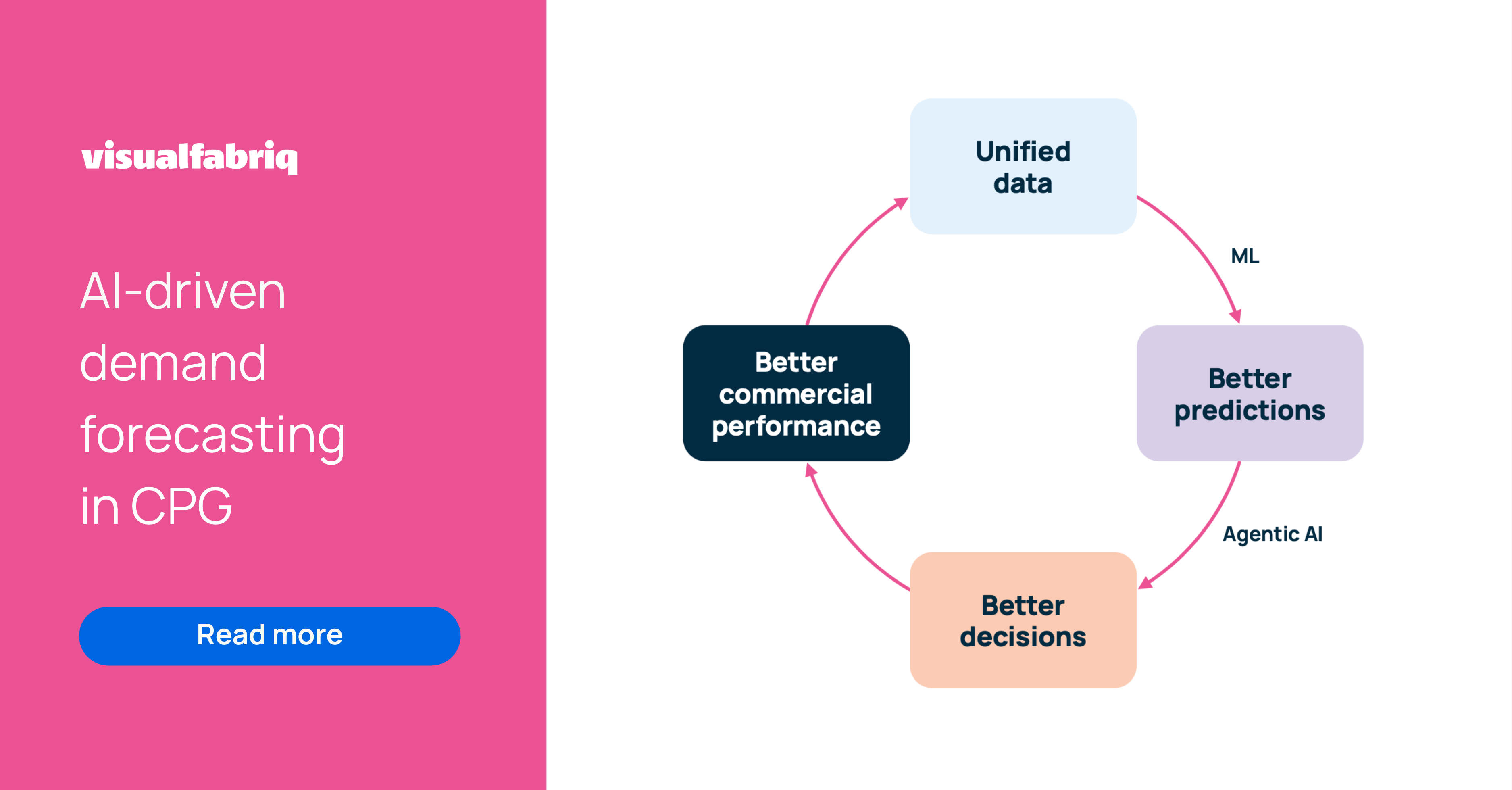
Demand forecasting is a cornerstone of production planning, inventory management, and revenue performance in consumer-packaged goods (CPG); and it’s under pressure.
CPG has always dealt with fragmented data, but today there is more of it, from more sources, and with higher expectations for speed, granularity, and accuracy. Add sudden shifts in shopper behavior and external disruptions that make past assumptions unreliable, and traditional ways of working are increasingly stretched.
That’s why AI-driven demand forecasting has become essential. Machine learning improves forecast accuracy by learning from complex, multi-source data—at scale.
But accuracy alone is no longer enough.
The real challenge is not generating forecasts; it’s using them effectively.
Why AI demand forecasting has become essential for CPG
Demand forecasting has always been critical in CPG. But the speed, complexity, and unpredictability of today’s markets require more advanced tools than traditional time series regression models can provide.
AI for demand forecasting enables CPG organizations to:
- Capture complex, nonlinear patterns across multiple data sources
- Adapt to new inputs far faster than traditional models
- Reduce bias through automated, data‑driven learning
- Deliver granular forecasts down to the SKU (stock-keeping unit) level
- Incorporate known drivers such as macroeconomic and category trends, distribution changes, and competitor activity
By moving from manual adjustments to AI-driven forecasting, CPGs can respond faster to both routine fluctuations and unexpected market shocks, while planners focus on judgment and exceptions rather than number crunching.
What AI-based demand forecasting really means
AI-based demand forecasting uses machine learning (ML) models—including neural networks, gradient boosting, and advanced time-series algorithms—to uncover patterns hidden in vast, multidimensional datasets.
At their core, these models produce deterministic forecasts: a consistent baseline outcome for a given set of inputs.
Compared to traditional approaches, machine learning in demand forecasting enables:
- Continuous model adaptation instead of periodic recalibration
- Processing of thousands of variables at scale
- Modeling of complex interactions between promotions, pricing, and external factors
- Granular forecasting across products and accounts
- AI doesn’t replace human expertise; it augments it, providing a stronger analytical foundation for planning.
The data foundation behind accurate forecast
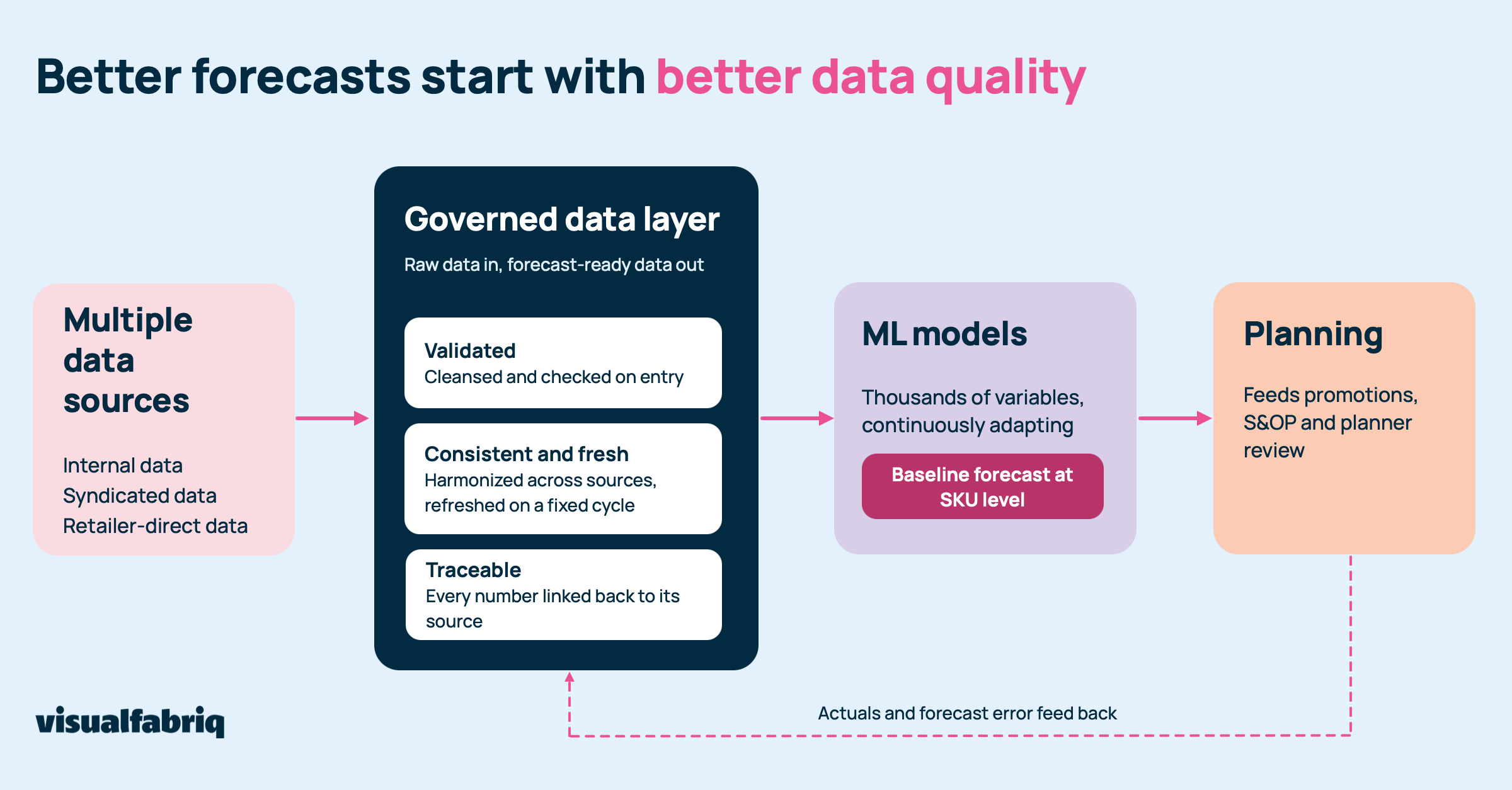
High‑performing AI forecasting depends on data diversity and quality. The foundation:
- Internal data: sales history, promotions, pricing, distribution, and inventory
- External data: macroeconomic signals, competitor activity, and category trends
- Structured processing: data refreshed in consistent cycles to keep models up to date
- Governance: controls for data quality, consistency, and traceability
AI can process more data than any manual approach. But without a reliable data foundation, even the most advanced models struggle to deliver consistent results.
What machine learning actually changes
Machine learning sits at the core of modern AI-based demand forecasting; but its role is often misunderstood.
It does not make decisions.
And it does not replace human judgment.
Instead, it improves how forecasts are generated:
- Automating model selection and tuning
Detect patterns across products, retailers, and seasonality without manual intervention - Producing reliable baselines at scale
Refresh forecasts across thousands of SKUs - Separating signal from noise
Ensure forecasts reflect true demand behavior - Providing a consistent starting point
A stable baseline teams can align around
Underneath, machine learning handles high-volume, high-granularity data processing—freeing up teams to focus on exceptions rather than manual recalculation.
Result:
More reliable forecasts—and a stronger foundation for decision-making.
From single forecasts to scenario understanding
Forecasts provide a consistent baseline, but business decisions rarely depend on a single outcome.
In practice, teams need to understand how demand changes when assumptions change:
- What happens if discount depth increases?
- What if a promotion overlaps with another campaign?
- How do retailer-specific behaviors affect demand?
By adjusting inputs—such as promotions, pricing, or external factors—teams can explore multiple scenarios, each producing a new, equally consistent outcome.
This is how uncertainty is handled in practice:
- Not through abstract probability distributions
- But through concrete, business-relevant scenarios
Where AI makes the biggest difference: promotion-heavy categories
This becomes especially critical in promotion-heavy categories, where small changes in assumptions can significantly impact demand.
In these environments, forecasting is inherently more complex:
- Overlapping promotions distort demand patterns
- Retailer forward buying obscures true consumption
- Post-promotion effects are difficult to quantify
- Assortment changes and product switches add further volatility
Traditional approaches struggle to isolate these effects.
AI‑driven forecasting improves accuracy by:
- Separating baseline from incremental demand
- Modeling promotional mechanics and timing
- Accounting for retailer-specific behavior
- Estimating post‑promotion effects
The payoff: More reliable forecasts in complex environments, leading to better service levels, reduced waste, and stronger promotion return on investment (ROI).
Why accuracy alone doesn't solve the problem
Even with advanced machine learning models and the ability to explore multiple scenarios, many CPG organizations still struggle to act on forecasts.
Because the real challenge isn’t just prediction; it’s interpretation and alignment.
Forecasts provide a baseline.
Scenarios show how outcomes change.
But turning those outputs into decisions requires:
- Aligning sales, finance, and supply teams
- Prioritizing what matters across thousands of signals
- Translating model outputs into business context
- Moving fast enough to act on changing conditions
In practice, this is where most processes break down.
Different teams interpret the same forecast differently.
Scenario analysis becomes slow and manual.
Decisions are delayed, or based on partial information.
In other words:
Better forecasts don’t automatically lead to better decisions.
Common challenges in AI-driven demand forecasting
Even with the right models in place, realizing the full value of AI-driven forecasting requires more than technology.
Organizations typically face a combination of technical and operational challenges:
- Data quality and consistency
Incomplete, inconsistent, or misaligned data weakens model performance and trust - Lack of transparency
“Black box” perceptions make it difficult for teams to validate and adopt forecasts - Market volatility
Sudden disruptions challenge even well-performing models - Fragmented ways of working
Sales, finance, and supply teams often operate on different assumptions and timelines - Manual, time-consuming analysis
Significant effort is still required to interpret outputs and prepare decisions - Concerns about control and ownership
Users may hesitate to rely on models if they feel disconnected from the outcomes
These challenges are not solved by better models alone.
They highlight a broader gap between forecast generation and decision-making.
From predictions to decisions: The role of Agentic AI
As forecasting matures, the next step isn’t more complex models; it’s helping teams use them effectively.
This is where agentic AI comes in.
Important distinction:
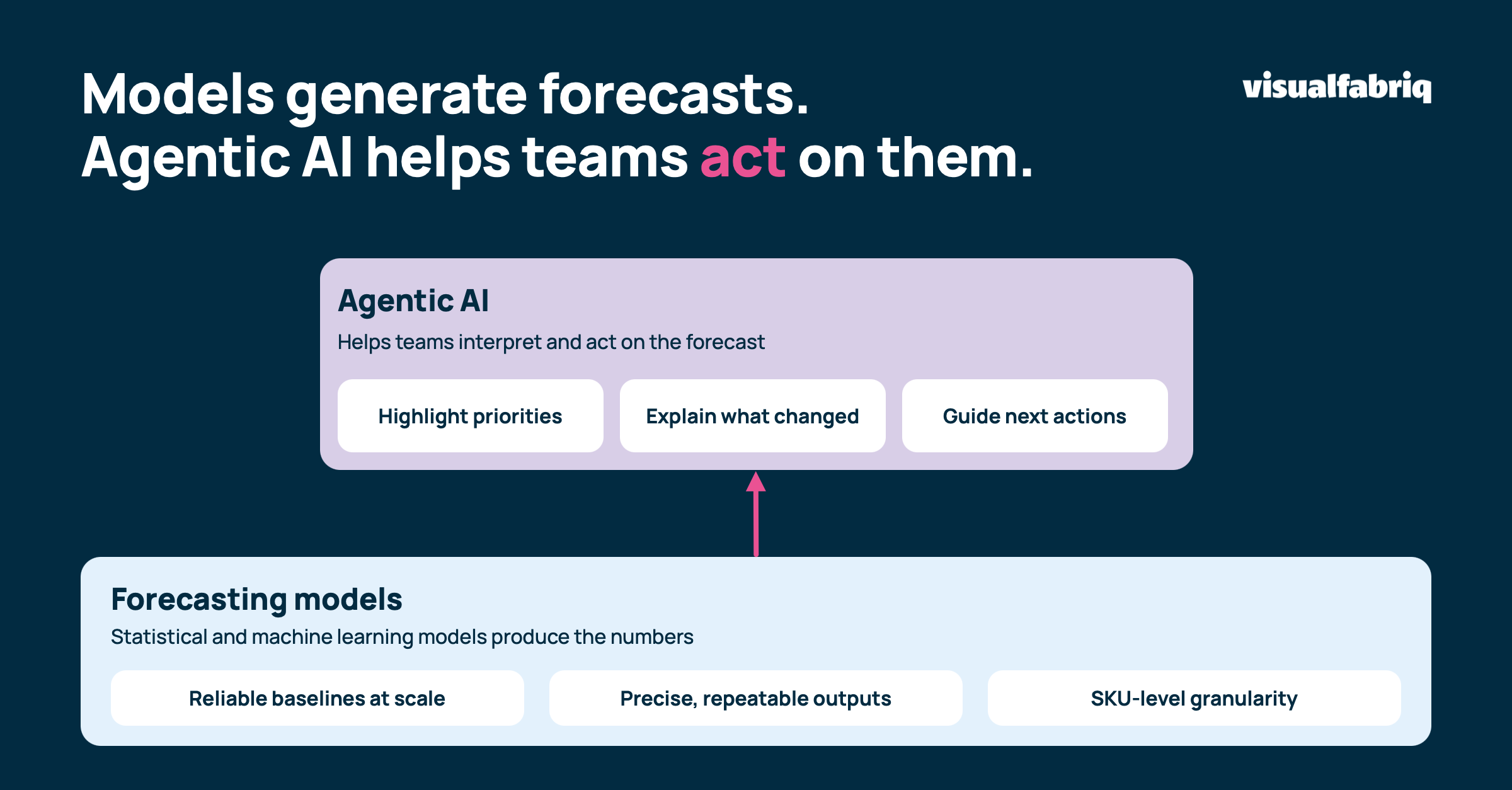
Forecasting remains the role of statistical and machine learning models that are designed to produce precise, repeatable numerical outputs.
Large language models (LLMs), while powerful for language tasks, are not designed to perform these calculations.
Instead, agentic AI operates on top of forecasting models.
It does not generate forecasts; it helps teams interpret and act on them. In practice, this means:
- Focusing attention where it matters
Surfacing anomalies, risks, and outliers across thousands of data points - Explaining what changed—and why
Translating model outputs into clear, business-relevant insights - Guiding next actions
Suggesting where to look, what to validate, and which decisions to consider - Supporting scenario thinking
Helping teams explore options before committing spend or plans - Accelerating analysis and workflows
Reducing manual analysis and improving consistency across teams
Agentic AI solutions like Assistant Mike illustrate this shift.
They don’t replace forecasting models; they bring them to life, turning predictions into actionable guidance.
Net effect:
Not just better forecasts but faster, more consistent, and more aligned decision-making.
What successful CPG teams do differently
Leading organizations approach AI forecasting end to end:
- Build on clean, governed data
Ensure consistency across sales, finance, and planning - Keep models explainable
Trust drives adoption—not complexity - Design for exception-based workflows
Focus human effort where it adds the most value - Start focused, then expand
Prove impact in one area before scaling - Move beyond prediction toward action
Shift from “what will happen” to “what should we do next”
The future of Demand Forecasting in CPG
AI has already transformed how forecasts are generated.
The next shift is how they are used.
Forward-looking organizations are moving from:
- Better predictions
→ to faster, more aligned execution
Modern demand forecasting is:
- Reliable enough to trust
- Understandable enough to validate
- Actionable enough to use
And increasingly, guided by agentic AI that helps teams focus, interpret, and act at the pace the business requires.
Explore AI-driven demand forecasting in practice
See how predictive modeling and decision support come together in practice for CPG teams in our AI-powered Demand Forecast Master solution.
Prefer a more hands-on experience?