-2.png "What is Agentic Revenue Growth Management?")
Agentic revenue growth management (agentic RGM) is the application of semi-autonomous AI agents to CPG commercial decision-making — including pricing, trade promotion optimization, demand forecasting, and assortment — replacing manual analysis with governed, real-time decision intelligence that continuously monitors, explains, and acts on commercial signals.
Agentic RGM systems operate through coordinated autonomous AI agents that perceive changes in the commercial environment, reason across multiple datasets and planning layers, and execute multi-step workflows toward defined business goals. These multi-agent systems for RGM bring together specialized agents for pricing, promotions, and forecasting, working through AI orchestration to produce a single, aligned commercial recommendation. High-impact decisions remain human-in-the-loop, with explicit guardrails defined by the business.
Applied to a real commercial scenario, promotions are often planned months in advance and rarely revisited once they are in-flight. As baseline demand shifts — for example due to broader distribution or competitor activity — the original assumptions behind a promotion no longer hold. In this context, an agentic RGM system identifies when performance is at risk, recalculates trade rates, volume, and P&L impact, and prepares a revised recommendation for review before the commercial impact is locked in.
This approach differs fundamentally from traditional revenue growth management technologies. Dashboards present historical data. Query-based (reactive) assistants respond when prompted. Automation agents execute predefined tasks. None of these continuously connect insight to proposed actions without being asked.
In contrast, an agentic RGM system identifies risks and opportunities as they emerge, proposes specific actions, and prepares them for governed execution. The result is not faster reporting, but a fundamentally different operating model for commercial decision-making in CPG.
What is agentic AI — and how does it apply to CPG?
Agentic AI refers to a class of systems built from autonomous AI agents that reason across complex commercial context, and take goal-oriented actions within defined boundaries. What distinguishes these systems is not just their ability to generate outputs, but their ability to connect data, context, and business intent across multiple domains
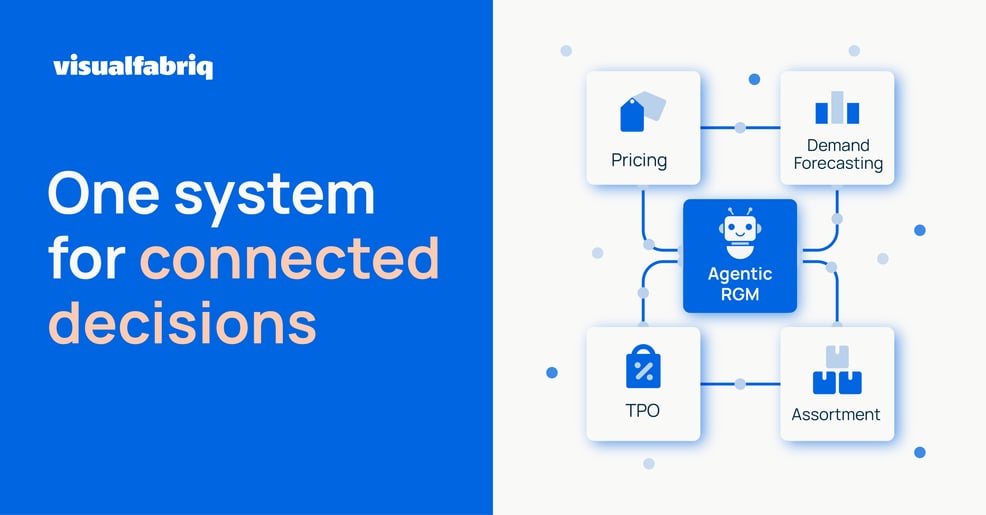
In a CPG context, this distinction is critical. Commercial decisions rarely exist in isolation. Pricing affects promotional performance. Promotions impact demand forecasts. Forecasts shape supply and revenue expectations. Traditional tools treat these as separate processes. Agentic AI for CPG connects them into a single decision layer.
This is what defines agentic AI for CPG: not isolated models, but coordinated systems that operate across the full commercial landscape. This is enabled by AI orchestration for pricing and promotions CPG — coordinating specialized agents into a single commercial decision layer. A pricing agent, a promotions agent, and a forecast agent each perform distinct roles, but do not operate independently. They exchange information, trigger each other’s workflows, and align on a single commercial outcome.
The practical impact is that decisions no longer need to be resolved sequentially. Instead of analyzing a promotion, then checking pricing, then validating the forecast, these steps can be connected in one governed flow. The output is not a set of disconnected insights, but a unified recommendation that reflects pricing, trade spend, and demand implications simultaneously.
For CPG teams, this introduces a new operating model. Agentic AI does not replace existing planning processes — it augments them with a layer of decision intelligence that continuously connects data, models, and actions. The result is a system that scales commercial decision-making beyond what manual analysis or standalone tools can realistically support.
What is revenue growth management — and why does it still frustrate CPG teams?
Revenue growth management (RGM) is the commercial discipline focused on defining how a company drives profitable growth — through pricing strategy, trade investment choices, portfolio decisions, and customer-level tactics. In mature CPG organizations, it shapes the strategic choices that determine where growth comes from and how margin is protected.
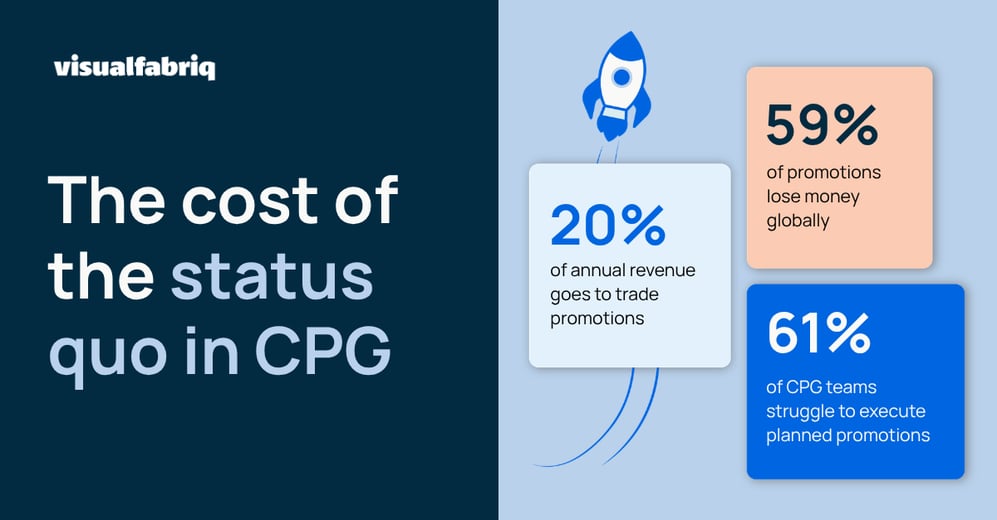
That strategic importance is one reason the frustration is so persistent. “How analytics can drive growth in consumer-packaged-goods trade promotions” (McKinsey & Company) states that CPG companies worldwide invest about 20 percent of their revenue annually in trade promotions, and that 59 percent of promotions lost money globally, rising to 72 percent in the United States.
The problem is not that leading CPG teams lack systems. It is that even mature RGM environments often run pricing, promotions, forecasting, and business review cycles on different cadences. Strategies are defined, plans are loaded, and execution moves forward — but the original commercial logic is not always revisited as assumptions shift, market context changes, or baselines evolve. This is where RGM and net revenue management can lose connection to the in-flight business.
External benchmarking reinforces that diagnosis. The Promotion Optimization Institute says that 61 percent of respondents reported difficulties executing planned promotions (POI 2026 State of the Industry reporting).
How agentic RGM works: the Answer → Solve → Act model
Agentic revenue growth management operates through three connected modes: Answer, Solve, and Act — moving from commercial insight to governed recommendation and follow-through.
Answer surfaces what has changed, why it matters, and what the likely commercial implications are — without requiring manual investigation. The system translates signals into decision intelligence: what happened, what caused it, and where attention is needed.
Solve determines the best response. Given a margin risk or forecast deviation, the system evaluates the relevant commercial levers — trade rate, discount depth, uplift, baseline demand, and P&L impact — and proposes a specific, commercially viable action. All financial outputs are generated through deterministic, auditable tools, ensuring that every recommendation is precise, explainable, and grounded in the underlying commercial logic.
Act prepares the next step under defined business guardrails. Rules are set in plain language — for example, margin thresholds for promotions — and enforced consistently across workflows. High-stakes decisions are routed for human approval, ensuring control is maintained.
A simple before-and-after makes the difference clear:
Before: a Key Account Manager notices a risk late, gathers data from multiple systems, rebuilds assumptions in Excel, checks with finance, and prepares a recommendation manually.
After: the system detects the issue early, explains the commercial impact, recalculates the relevant scenario, and prepares a governed recommendation for review in one flow.
That is the practical architecture of agentic RGM: Answer identifies the issue, Solve determines the best response, and Act turns that response into a recommendation that is ready for governed follow-through. The result is a decision intelligence platform CPG teams can trust — one that does more than report or assist, and instead helps commercial teams operate with greater speed, consistency, and control.
Agentic RGM vs query-based (reactive) assistants and dashboards: what is the difference?
Not all AI-enabled commercial tools operate in the same way. In CPG commercial planning, it is useful to distinguish between three categories: dashboards, query-based (reactive) assistants, and agentic RGM systems. Each plays a role, but they differ fundamentally in how they interact with data, decisions, and action.
At a high level, the difference is simple:
A dashboard shows. A query-based assistant responds. An agentic system works.
Core differences at a glance
| Capability | Dashboard | Query-based (reactive) assistant | Agentic RGM system (e.g., Visualfabriq, Assistant Mike) |
| Primary role |
Presents data and visualizations (historical or forecast) for the user to interpret |
Interprets data and answers questions when prompted |
Interprets across specialist agents and prepares recommended actions for approval |
| User interaction |
User must open it and read it |
Prompted — returns a single answer |
Prompted — orchestrates multiple agents to resolve the task and prepare next steps |
| Timing |
Reactive(after the fact) |
Reactive (on request) |
Proactive and continuous |
| Decision-making |
Human interprets, decides, and acts |
Human asks, interprets, then decides |
System proposes and prepares; humans approve under guardrails |
| Scope |
Pre-built views and KPIs |
General-purpose reasoning, limited to the question asked |
Multi-agent reasoning across pricing, promotions, and forecasting |
| Numbers & Trust |
Shows stored, pre-calculated values |
Predicts and generates figures, may pull in external data — can hallucinate or mislead |
Never predicts numbers: deterministic tools calculate, fenced to your governed data, fully auditable |
| Security & Governance |
Access set per report or role |
No role-based security; doesn't hold company rules or terminology |
Inherits your role-based permissions (never shows restricted data like COGS); holds your guardrails, prompts, KPI definitions and company-specific abbreviations |
| Actionability |
No action layer |
Suggests insights; no execution |
Moves from insight to governed, human-approved action |
| Learning model |
Static reporting logic |
Improves responses over time |
Evolves continuously via AI-driven CPG decision intelligence platform |
Dashboards: visibility without action
Dashboards remain the most widely used tools in revenue growth management. They provide structured visibility into historical performance: sales, margins, trade spend, and promotional results.
Their limitation is not accuracy, but dependency. A dashboard requires a user to identify the issue, interpret the data, and decide what to do next. It does not surface risks proactively, and it does not connect signals across the commercial plan. As a result, dashboards are inherently reactive — they explain what has already happened, not what is about to happen.
Query-based assistants: assistance without initiation
Query-based assistants (sometimes described in the market as AI copilots) add a conversational layer on top of data. They help users ask questions in natural language and retrieve answers faster, but they still depend on a human to initiate the interaction.
They do not monitor commercial performance continuously, nor do they decide when something requires attention. In practice, this means that the quality of output depends on the quality and timing of the question. If a risk is not explicitly queried, it remains unseen.
This is the core distinction in the query-based assistant vs autonomous agent for trade promotion management: query-based (reactive) assistants assist analysis, while agentic systems initiate it.
Agentic RGM systems: continuous decision intelligence
Agentic RGM systems move beyond insight toward governed recommendation and follow-through, preparing next steps under guardrails instead of requiring each action path to be assembled manually.
Rather than waiting for input, the system identifies deviations, risks, and opportunities as they emerge. It reasons across multiple agents — pricing, promotions, and forecasting — and produces a coordinated recommendation that reflects the full commercial impact.
Most importantly, it does not stop at insight. Under defined guardrails, the system prepares recommended actions and routes them for approval. This is what defines an autonomous agent in a CPG commercial context: not unchecked automation, but governed, proactive support for better decision-making.
The practical difference
The difference between these approaches becomes clear in daily work.
A dashboard explains what happened.
A query-based assistant answers why when asked.
An agentic system identifies risks early and prepares the next best action before they materialize.
The shift is not incremental. It is a move from tools that support analysis to systems that drive outcomes.
Why CPG-native agentic AI outperforms generic AI platforms
The value of agentic revenue growth management lies in changing how commercial decisions are made — not by accelerating analysis, but by improving timing, coordination, and execution across the entire RGM landscape.
In practice, this translates into a set of measurable advantages that traditional tools and generic AI platforms struggle to deliver.
1. Earlier intervention, not faster analysis
In most CPG environments, issues are identified after they begin to impact performance. Promotions are reviewed days before execution. Forecast deviations are flagged once variance becomes visible. By that point, options are limited.
Agentic RGM shifts this forward. By continuously monitoring pricing, promotions, and demand signals, the system identifies risks and opportunities when they are still actionable. This earlier intervention window allows commercial teams to adjust trade rates, timing, or assumptions before financial impact is locked in.
The benefit is not speed for its own sake, but better decision timing, which directly affects margin and revenue outcomes.
2. Coordinated decision-making across commercial levers
Revenue growth management depends on interconnected decisions. Pricing, promotions, assortment, and demand forecasting all influence each other, yet in most organizations they are still managed in separate workflows.
An agentic AI platform for CPG coordinates these decisions through multi-agent systems for RGM. A change in pricing immediately feeds into promotional ROI, which in turn adjusts demand expectations and financial projections. The system resolves these dependencies in one step, rather than across multiple teams and cycles.
This reduces misalignment between functions and ensures that every decision reflects its full commercial impact — not just a single dimension of performance.
3. Continuous control over trade spend and margin
Trade spend optimization is one of the most complex and high-impact areas in CPG. With trade spend often representing 15–25% of gross revenue, even small inefficiencies create significant financial leakage. These capabilities are particularly important in trade promotion optimization, where timing and coordination directly impact margin outcomes.
Agentic RGM introduces continuous monitoring and intervention. Instead of reviewing promotions in isolation, the system evaluates every active event against defined margin thresholds and business rules. At-risk scenarios are surfaced early, and corrected before execution.
This enables a level of control that is difficult to achieve manually: consistent enforcement of commercial guardrails across every promotion, every customer, and every market.
4. From fragmented tools to a unified decision intelligence platform
Most CPG commercial environments rely on a combination of trade promotion management, pricing tools, and demand forecasting systems that operate independently. This fragmentation creates delays, inconsistencies, and duplicated effort.
An agentic RGM approach replaces this with a decision intelligence platform CPG teams can operate on as a single layer. Data, models, and actions are connected, allowing agents to reason across the full commercial picture instead of isolated datasets.
Platforms like Visualfabriq are designed as AI-native commercial excellence platforms, meaning they are built specifically for these interconnected workflows rather than retrofitted onto generic data infrastructure.
5. Built for CPG complexity, not general-purpose use
Generic AI platforms excel at pattern recognition and text generation, but they lack the structural understanding required for CPG commercial decisions. They do not inherently model trade promotion mechanics, price pack architecture, or route-to-market complexity.
A CPG-native agentic AI platform embeds this domain knowledge directly into its agents. A promotions agent understands uplift dynamics and cannibalization. A pricing agent understands price ladder logic. An LLM-powered price-pack architecture model can evaluate mix shifts and quantify their P&L impact.
This domain specificity ensures that recommendations are not only technically correct, but commercially meaningful.
6. Scalable decision automation without loss of control
One of the biggest constraints in traditional RGM is capacity. Commercial teams cannot continuously monitor every promotion, scenario, and forecast at the level of detail required.
This is where some vendors talk about decision automation in RGM. In practice, the more useful idea is governed follow-through: codified guardrails that define what the system can recommend, what requires approval, and how decisions are prioritized. The goal is not unchecked autonomy, but scalable support for better commercial decisions.
The result is AI-powered revenue growth management software where thousands of micro-decisions can be managed consistently, without increasing headcount or compromising control.
The net effect
Taken together, these benefits redefine what is practically achievable in revenue growth management.
Instead of:
- reacting to issues after they occur
- analyzing decisions in isolation
- relying on manual coordination across teams
CPG organizations can move toward:
- earlier, actionable intervention
- coordinated decision-making across all commercial levers
- continuous, governed execution at scale
This is not an incremental improvement to existing tools. It is a shift toward an AI-native commercial excellence platform where commercial performance is managed continuously rather than reviewed periodically.
Use cases: where agentic RGM creates the most value in CPG
Agentic AI use cases for CPG deliver the most value where commercial complexity, timing pressure, and financial impact intersect — areas where manual analysis struggles to scale and earlier, coordinated decisions directly improve outcomes.
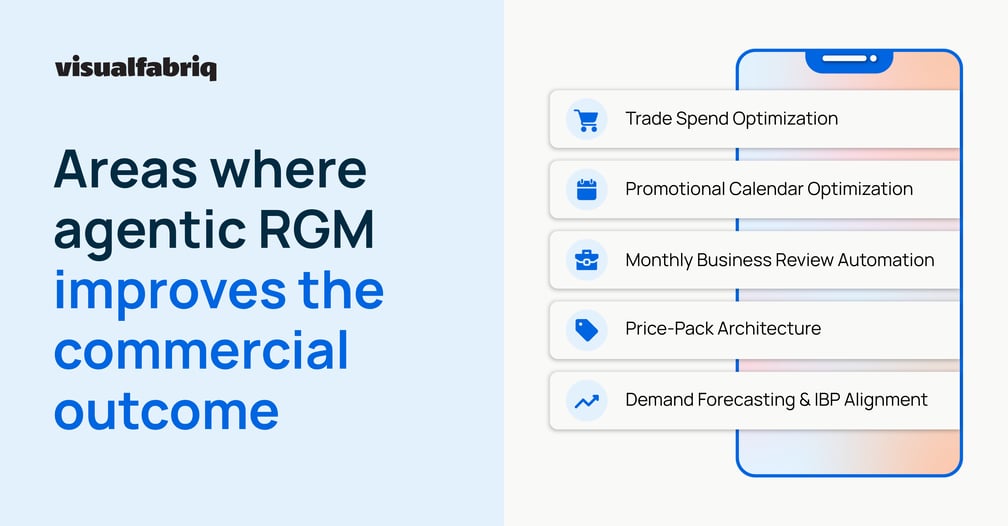
Below are the highest-impact use cases for agentic revenue growth management in practice.
1. Trade spend optimization: continuous control over margin risk
In traditional workflows, promotions are evaluated at set checkpoints — often too late to meaningfully intervene. This creates a persistent risk of trade spend leakage CPG teams cannot detect at scale.
With agentic RGM, an autonomous trade investment optimizer continuously monitors every active and planned promotion against defined guardrails such as margin thresholds and ROI expectations. At-risk events are flagged weeks before execution, and revised trade rates or mechanics are proposed automatically.
Outcome:
- 0.25%–2% trade spend optimization improvement
- Earlier intervention before margin impact is locked in
- Consistent enforcement of commercial rules across all promotions
2. Promotional calendar optimization: reducing cannibalization and inefficiency
Promotional calendars are often planned SKU by SKU or account by account, without full visibility into cross-product effects. This leads to cannibalization, suboptimal timing, and unnecessary margin dilution.
Agentic AI systems scan the full promotional calendar continuously, identifying overlaps, conflicting promotions, and inefficient sequencing. They surface a prioritized list of adjustments that improve overall promotional effectiveness rather than optimizing in isolation.
Outcome:
- Reduced cannibalization across SKUs
- Improved timing and sequencing of promotions
- Higher promotional ROI across the full portfolio
3. Monthly business review automation: from 3 days to 30 seconds
Preparing a monthly business review (MBR) typically requires consolidating data from multiple systems, reconciling assumptions, and manually explaining performance drivers.
An agentic RGM system, such as Visualfabriq's Assistant Mike, automates this process end to end. It identifies key variances versus plan, explains the underlying drivers, and generates a structured performance narrative with supporting data.
A leading CPG commercial team described the shift simply: “What used to take 3 days now takes 30 seconds.”
Outcome:
- 40–60% reduction in routine analysis time
- MBR preparation reduced from days to minutes
- Consistent, data-backed performance narratives
4. Price-pack architecture optimization: protecting mix and margin
Changes in pricing or promotions often have unintended consequences on product mix, eroding margin over time. These effects are difficult to detect manually, especially across large portfolios and markets.
An LLM-powered price pack architecture capability continuously evaluates mix performance, detects erosion patterns, and quantifies their financial impact. It then proposes structural adjustments — such as repricing, pack resizing, or promotional changes — grounded in commercial data.
Outcome:
- Early detection of mix and margin erosion
- Quantified impact on net revenue and profitability
- Data-backed recommendations for structural pricing decisions
5. Demand forecasting and IBP alignment: proactive demand shaping
Demand forecasting for CPG is often reactive, with deviations identified after they begin to impact operations. Disconnected commercial and supply planning processes make it difficult to intervene early.
Agentic AI-driven demand sensing CPG systems continuously monitor baseline demand, promotional uplift, and external signals. They flag deviations before they hit actuals and align commercial and supply decisions through a shared, up-to-date view.
This enables proactive demand shaping rather than reactive correction.
Outcome:
- Earlier detection of forecast deviations
- Improved alignment between commercial planning and IBP
- Reduced lost sales and excess inventory risk
The common pattern across use cases
Across all these scenarios, the value of agentic RGM comes from the same underlying shift:
- From periodic analysis → continuous monitoring
- From isolated decisions → coordinated action across functions
- From manual workflows → scalable decision intelligence
These are not isolated improvements to existing processes. They represent a new way of operating: one where commercial performance is actively managed in real time, rather than reviewed after the fact.
Conclusion
Agentic revenue growth management is not a new layer on top of existing tools. It is a shift in how CPG commercial decisions are made.
Agentic RGM in CPG isn’t built to replace human decisions, but to improve how, when, and with what context those decisions are made.
For years, RGM has relied on dashboards, models, and manual workflows. These improved visibility, but not execution. Commercial teams still carry the burden of reconnecting in-flight performance with the original RGM strategy, validating assumptions, and determining the next step under time pressure.
Agentic RGM helps close that gap. By introducing semi-autonomous AI agents that monitor performance, reason across commercial levers, and move toward governed action, it shifts RGM from a reactive discipline to a proactive operating model.
As commercial complexity increases — more promotions, tighter margins, faster retailer cycles —manual processes no longer scale. Agentic systems do.
The question is no longer whether AI will shape revenue growth management, but what kind of AI will define it: reactive tools that support analysis, or agentic systems such as Visualfabriq that drive coordinated, governed action.
See agentic RGM in action
Visualfabriq is the CPG-native agentic AI platform that unifies RGM, IBP, and trade promotion optimization in one system. Assistant Mike monitors your commercial reality continuously, explains what has changed, and moves from insight to governed action — with deterministic, auditable numbers.
.svg)
.png)